Revised 6may11
\textit{$\C$ 2010, Prof. George K. Francis, Mathematics Department, University of Illinois} \begin{document} \maketitle \section{Introduction} The second module of this course addresses the geometry which Euclid
of Alexandria (ca -300) created. In particular, we are concerned with
\textit{Book I} of his \texit{Elements}, which begins with his Postulates,
and ends with his proof of the Pythagorean Theorem (Propositions 47) and
its converse (Proposition 48). For the first 28 propositions, Euclid
carefully avoids using his fifth, the \textit{Parallel Postulate}.
This body of plane geometry is
known as \textit{Absolute Geometry}. Nowadays, it is also called
\textit{Neutral Geometry} because it does not takes sides on whether to
accept or reject the parallel postulate.
It was Euclid's intention of proposing his Postulates, together with
informal definitions and common notions, as given, and to derive the
propositions logically from them. Euclid, however, made a number of
additional assumption without calling any particular attention to them.
Geometers corrected these deficiencies over the subsequent 2200 years.
The final formulation Euclid's axioms was made by David Hilbert (ca 1900).
Robert Campbells praphrase of
Hilbert's Axioms make easy reading.
In this course we will neither follow Euclid and present his proofs in
the classical progression, nor will we study Hilbert's axiomatic system
in any great detail. The former is purely of historical interest, and
the latter is far too technical and difficult for a first course in
college geometry.
We will discuss the high points of absolute geometry, giving proofs
only as needed to appreciate the Euclid's grand invention. When we
come to the great divide between absolute and Euclidean geometry,
we will study the structure of the theorems and proofs in considerable
detail.
A brief look into the Elements between Propositions 30 and 46 will be
followed by several proofs of Pythagoras' theorem. There are many more
on the WWW. (There is even one by President Garfield.)
The module will conclude with Birkhoff's very economical set of
axioms (only 4 as against Hilbert's 21) . The difference of these two axiomatic
systems is considerable. Birkhoff's axioms are built on top of the
entire edifice of real numbers and their arithmetic. Hilbert's is not.
Indeed, numbers and their arithmetic appear as objects inside Hilbert's
geometry. In other words, the axiomatic arithmetic of real numbers has a
model inside geometry.
The great achievement of Hilbert and his colleagues was to show that
geometry and arithmetic are equi-consistent. It is not necessary to
choose between them, we accept both arithmetic and geometry as equally
certain.
On the other hand, since Rene Descartes (ca 1600), we have based geometry
on the properties of the real numbers, in the form of analytic geometry,
a.k.a. \textit{Cartesian Geometry}. We will consider Birkhoff's
axioms, because there are fewer of them, and they already assume the
properties of the reals, and show that they have a model inside Cartesian
geometry.
\section{Concordance with Hvidsten's Text}
Our exposition differs from that of Hvidsten in that it is takes less
time, but is also not as deep and detailed as his. Hvidsten's text is
designed to be useful for many different approaches to the this subject.
Should you ever need to present Euclid's geometry in the classical way,
you can use the entire 2nd chapter of the textbook. While you should
definitely read sections 1.6 and 2.1, our chief resource for the next
three weeks is Appendix A (on Book I of Euclid's Elements) of Hvidsten.
Of course, we shall also use GEX, and there are lessons, like the one you are
now reading.
In Section 1.7, Hvidsten introduces what he calls a \textit{concrete
axiomatic system} using his software, the \textit{Geometry Explorer.}
We have done an equivalent experiment in a GEX2.0 lab on the
exterior angle theorem. Nevertheless,
you are encouraged to read through this section too for supplemental
enlightenment.
\section{Definition of Absolute Geometry}
We will take the simplest
approach and consider all the definitions, theorems and proofs in Euclid's
Elements up to and including Proposition 28 as constituting absolute
geometry. Another, more practical definition would be to say that any
theorem that is true in both Euclidean and Hyperbolic geometry is part
of absolute geometry.
For example, that an exterior angle of a triangle is greater than either
opposite interior angle (XAT) is true in all models in GEX. Indeed, this
is Proposition 16 in Euclid. As we saw in the GEX lab, it is also
true in hyperbolic geometry. But in Euclidean geometry, GEX reveals that
more is true. The Euclidean Exterior Angle Theorem (EXAT) says that the
exterior angle is the sum of the opposite interior angles. This is false
in hyperbolic geometry. Therefore, EXAT cannot be proved inside absolute
geometry. The last lesson of this course will reveal that the amount by
which EXAT fails in hyperbolic geometry, gives the area of the triangle.
So, how can you tell that a theorem is part of absolute geometry, or
requires the Parallel Postulate to be true? One way is to study Euclid's
Elements. Since $48>28$ we know that the Pythagorean Theorem (Prop. 48)
is not a part of absolute geometry. Another is to use GEX and check
whether or not the theorem holds in both Euclidean and in non-Euclidean
geometry, then it must be and absolute theorem.
The second module of this course addresses the geometry which Euclid
of Alexandria (ca -300) created. In particular, we are concerned with
\textit{Book I} of his \texit{Elements}, which begins with his Postulates,
and ends with his proof of the Pythagorean Theorem (Propositions 47) and
its converse (Proposition 48). For the first 28 propositions, Euclid
carefully avoids using his fifth, the \textit{Parallel Postulate}.
This body of plane geometry is
known as \textit{Absolute Geometry}. Nowadays, it is also called
\textit{Neutral Geometry} because it does not takes sides on whether to
accept or reject the parallel postulate.
It was Euclid's intention of proposing his Postulates, together with
informal definitions and common notions, as given, and to derive the
propositions logically from them. Euclid, however, made a number of
additional assumption without calling any particular attention to them.
Geometers corrected these deficiencies over the subsequent 2200 years.
The final formulation Euclid's axioms was made by David Hilbert (ca 1900).
Robert Campbells praphrase of
Hilbert's Axioms make easy reading.
In this course we will neither follow Euclid and present his proofs in
the classical progression, nor will we study Hilbert's axiomatic system
in any great detail. The former is purely of historical interest, and
the latter is far too technical and difficult for a first course in
college geometry.
We will discuss the high points of absolute geometry, giving proofs
only as needed to appreciate the Euclid's grand invention. When we
come to the great divide between absolute and Euclidean geometry,
we will study the structure of the theorems and proofs in considerable
detail.
A brief look into the Elements between Propositions 30 and 46 will be
followed by several proofs of Pythagoras' theorem. There are many more
on the WWW. (There is even one by President Garfield.)
The module will conclude with Birkhoff's very economical set of
axioms (only 4 as against Hilbert's 21) . The difference of these two axiomatic
systems is considerable. Birkhoff's axioms are built on top of the
entire edifice of real numbers and their arithmetic. Hilbert's is not.
Indeed, numbers and their arithmetic appear as objects inside Hilbert's
geometry. In other words, the axiomatic arithmetic of real numbers has a
model inside geometry.
The great achievement of Hilbert and his colleagues was to show that
geometry and arithmetic are equi-consistent. It is not necessary to
choose between them, we accept both arithmetic and geometry as equally
certain.
On the other hand, since Rene Descartes (ca 1600), we have based geometry
on the properties of the real numbers, in the form of analytic geometry,
a.k.a. \textit{Cartesian Geometry}. We will consider Birkhoff's
axioms, because there are fewer of them, and they already assume the
properties of the reals, and show that they have a model inside Cartesian
geometry.
\section{Concordance with Hvidsten's Text}
Our exposition differs from that of Hvidsten in that it is takes less
time, but is also not as deep and detailed as his. Hvidsten's text is
designed to be useful for many different approaches to the this subject.
Should you ever need to present Euclid's geometry in the classical way,
you can use the entire 2nd chapter of the textbook. While you should
definitely read sections 1.6 and 2.1, our chief resource for the next
three weeks is Appendix A (on Book I of Euclid's Elements) of Hvidsten.
Of course, we shall also use GEX, and there are lessons, like the one you are
now reading.
In Section 1.7, Hvidsten introduces what he calls a \textit{concrete
axiomatic system} using his software, the \textit{Geometry Explorer.}
We have done an equivalent experiment in a GEX2.0 lab on the
exterior angle theorem. Nevertheless,
you are encouraged to read through this section too for supplemental
enlightenment.
\section{Definition of Absolute Geometry}
We will take the simplest
approach and consider all the definitions, theorems and proofs in Euclid's
Elements up to and including Proposition 28 as constituting absolute
geometry. Another, more practical definition would be to say that any
theorem that is true in both Euclidean and Hyperbolic geometry is part
of absolute geometry.
For example, that an exterior angle of a triangle is greater than either
opposite interior angle (XAT) is true in all models in GEX. Indeed, this
is Proposition 16 in Euclid. As we saw in the GEX lab, it is also
true in hyperbolic geometry. But in Euclidean geometry, GEX reveals that
more is true. The Euclidean Exterior Angle Theorem (EXAT) says that the
exterior angle is the sum of the opposite interior angles. This is false
in hyperbolic geometry. Therefore, EXAT cannot be proved inside absolute
geometry. The last lesson of this course will reveal that the amount by
which EXAT fails in hyperbolic geometry, gives the area of the triangle.
So, how can you tell that a theorem is part of absolute geometry, or
requires the Parallel Postulate to be true? One way is to study Euclid's
Elements. Since $48>28$ we know that the Pythagorean Theorem (Prop. 48)
is not a part of absolute geometry. Another is to use GEX and check
whether or not the theorem holds in both Euclidean and in non-Euclidean
geometry, then it must be and absolute theorem.
 Euclid's first proposition showed how to construct an equilateral triangle
on a given base AB, directly from his postulates.
By Postulate 3 we have two circles, one centered
at A and the other at B, and with the same radius.
Euclid assumed that is was obvious that
the two circles intersected at two points, C and D. In Hilbert's geometry this
was not taken for granted. It had to be proved from prior theorems. But once
we do have a point there, both dashed segments are also radii of their respective circles. Hence the triangle is equilateral.
You should remember from high school geometry, that if we now connect C and D
with a line, this becomes the perpendicular bisector of the segment AB.
Euclid's first proposition showed how to construct an equilateral triangle
on a given base AB, directly from his postulates.
By Postulate 3 we have two circles, one centered
at A and the other at B, and with the same radius.
Euclid assumed that is was obvious that
the two circles intersected at two points, C and D. In Hilbert's geometry this
was not taken for granted. It had to be proved from prior theorems. But once
we do have a point there, both dashed segments are also radii of their respective circles. Hence the triangle is equilateral.
You should remember from high school geometry, that if we now connect C and D
with a line, this becomes the perpendicular bisector of the segment AB.
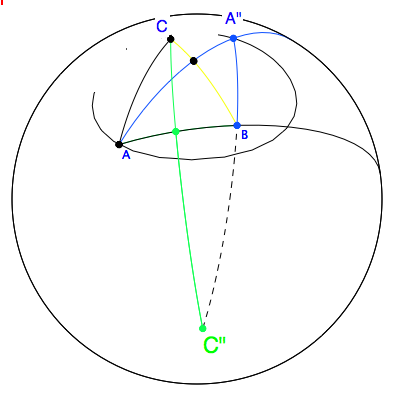 Recall what happens if you now repeat this construction with the other
median. The figure was constructed in the orthographic model of the
Euclidean plane in GEX so that things don't look too obvious. In this
figure we used a typically Euclidean construction to find the point A".
First the median from A was produced as a ray to infinity. Then, Postulate
3 was applied to the midpoint, A', of CB as center, and the median as radius.
The circle re-crossed the ray at A", hence A" doubles the median. The green
median was doubled by a translation, as usual. We showed that
$\angle BCA \cong \angle CBA" $. Similarly
$\angle BAC \cong \angle ABC" $. IT certainly looks like
$\angle ABC" \cong \angle \infty B A" $. But looks are deceiving.
Euclid realized that he could not prove that the line segments
$C"B$ and $A"B$ were collinear.
If they are collinear, then the exterior angle is indeed the sum of the two
opposite interior angles (EXAT). He did know a proof of EXAT using the Parallel
Postulate. Now we know why. The construction in a hyperbolic model reveals the
truth.
\subsection{Lab Experiment for the Exterior Angle Theorem: Part II}
Elsewhere we will write up the second half of the lab on the Exterior
Angle Theorem. But you should do this yourself now to make sure you
understood this lesson.
Recall what happens if you now repeat this construction with the other
median. The figure was constructed in the orthographic model of the
Euclidean plane in GEX so that things don't look too obvious. In this
figure we used a typically Euclidean construction to find the point A".
First the median from A was produced as a ray to infinity. Then, Postulate
3 was applied to the midpoint, A', of CB as center, and the median as radius.
The circle re-crossed the ray at A", hence A" doubles the median. The green
median was doubled by a translation, as usual. We showed that
$\angle BCA \cong \angle CBA" $. Similarly
$\angle BAC \cong \angle ABC" $. IT certainly looks like
$\angle ABC" \cong \angle \infty B A" $. But looks are deceiving.
Euclid realized that he could not prove that the line segments
$C"B$ and $A"B$ were collinear.
If they are collinear, then the exterior angle is indeed the sum of the two
opposite interior angles (EXAT). He did know a proof of EXAT using the Parallel
Postulate. Now we know why. The construction in a hyperbolic model reveals the
truth.
\subsection{Lab Experiment for the Exterior Angle Theorem: Part II}
Elsewhere we will write up the second half of the lab on the Exterior
Angle Theorem. But you should do this yourself now to make sure you
understood this lesson.
 \end{document}
Absolute Geometry versus Euclidean Geometry
\textit{$\C$ 2010, Prof. George K. Francis, Mathematics Department, University of Illinois} \begin{document} \maketitle \section{Introduction}
The second module of this course addresses the geometry which Euclid
of Alexandria (ca -300) created. In particular, we are concerned with
\textit{Book I} of his \texit{Elements}, which begins with his Postulates,
and ends with his proof of the Pythagorean Theorem (Propositions 47) and
its converse (Proposition 48). For the first 28 propositions, Euclid
carefully avoids using his fifth, the \textit{Parallel Postulate}.
This body of plane geometry is
known as \textit{Absolute Geometry}. Nowadays, it is also called
\textit{Neutral Geometry} because it does not takes sides on whether to
accept or reject the parallel postulate.
It was Euclid's intention of proposing his Postulates, together with
informal definitions and common notions, as given, and to derive the
propositions logically from them. Euclid, however, made a number of
additional assumption without calling any particular attention to them.
Geometers corrected these deficiencies over the subsequent 2200 years.
The final formulation Euclid's axioms was made by David Hilbert (ca 1900).
Robert Campbells praphrase of
Hilbert's Axioms make easy reading.
In this course we will neither follow Euclid and present his proofs in
the classical progression, nor will we study Hilbert's axiomatic system
in any great detail. The former is purely of historical interest, and
the latter is far too technical and difficult for a first course in
college geometry.
We will discuss the high points of absolute geometry, giving proofs
only as needed to appreciate the Euclid's grand invention. When we
come to the great divide between absolute and Euclidean geometry,
we will study the structure of the theorems and proofs in considerable
detail.
A brief look into the Elements between Propositions 30 and 46 will be
followed by several proofs of Pythagoras' theorem. There are many more
on the WWW. (There is even one by President Garfield.)
The module will conclude with Birkhoff's very economical set of
axioms (only 4 as against Hilbert's 21) . The difference of these two axiomatic
systems is considerable. Birkhoff's axioms are built on top of the
entire edifice of real numbers and their arithmetic. Hilbert's is not.
Indeed, numbers and their arithmetic appear as objects inside Hilbert's
geometry. In other words, the axiomatic arithmetic of real numbers has a
model inside geometry.
The great achievement of Hilbert and his colleagues was to show that
geometry and arithmetic are equi-consistent. It is not necessary to
choose between them, we accept both arithmetic and geometry as equally
certain.
On the other hand, since Rene Descartes (ca 1600), we have based geometry
on the properties of the real numbers, in the form of analytic geometry,
a.k.a. \textit{Cartesian Geometry}. We will consider Birkhoff's
axioms, because there are fewer of them, and they already assume the
properties of the reals, and show that they have a model inside Cartesian
geometry.
\section{Concordance with Hvidsten's Text}
Our exposition differs from that of Hvidsten in that it is takes less
time, but is also not as deep and detailed as his. Hvidsten's text is
designed to be useful for many different approaches to the this subject.
Should you ever need to present Euclid's geometry in the classical way,
you can use the entire 2nd chapter of the textbook. While you should
definitely read sections 1.6 and 2.1, our chief resource for the next
three weeks is Appendix A (on Book I of Euclid's Elements) of Hvidsten.
Of course, we shall also use GEX, and there are lessons, like the one you are
now reading.
In Section 1.7, Hvidsten introduces what he calls a \textit{concrete
axiomatic system} using his software, the \textit{Geometry Explorer.}
We have done an equivalent experiment in a GEX2.0 lab on the
exterior angle theorem. Nevertheless,
you are encouraged to read through this section too for supplemental
enlightenment.
\section{Definition of Absolute Geometry}
We will take the simplest
approach and consider all the definitions, theorems and proofs in Euclid's
Elements up to and including Proposition 28 as constituting absolute
geometry. Another, more practical definition would be to say that any
theorem that is true in both Euclidean and Hyperbolic geometry is part
of absolute geometry.
For example, that an exterior angle of a triangle is greater than either
opposite interior angle (XAT) is true in all models in GEX. Indeed, this
is Proposition 16 in Euclid. As we saw in the GEX lab, it is also
true in hyperbolic geometry. But in Euclidean geometry, GEX reveals that
more is true. The Euclidean Exterior Angle Theorem (EXAT) says that the
exterior angle is the sum of the opposite interior angles. This is false
in hyperbolic geometry. Therefore, EXAT cannot be proved inside absolute
geometry. The last lesson of this course will reveal that the amount by
which EXAT fails in hyperbolic geometry, gives the area of the triangle.
So, how can you tell that a theorem is part of absolute geometry, or
requires the Parallel Postulate to be true? One way is to study Euclid's
Elements. Since $48>28$ we know that the Pythagorean Theorem (Prop. 48)
is not a part of absolute geometry. Another is to use GEX and check
whether or not the theorem holds in both Euclidean and in non-Euclidean
geometry, then it must be and absolute theorem.
Question 1: Do you think the theorem that rectangles have four right angles is absolutely true? Experiment with a Euclidean and a hyperbolic model in GEX. Write your results into your Journal. Report a summary here.
\section{Book I of the Elements}
Euclid invites his students to accept a long list of \textit{common notions},
which are not particularly convincing. In fact, Hilbert insisted that the primitives
of an axiomatic system are technically undefined. Of course, once you interpret
them in a model, they have a meaning. But it depends on the model you use.
Until C. F. Gauss (ca 1800) everybody, and I mean everybody was convinced that
there was only one possible geometry. And even if we humans were imperfect in
formulating this ideal geometry, it was as much there as anything we know.
What is much more interesting for us, than arguing about the nature of a point
or a line, is the tremendous care Euclid took in arranging the theorem in a
logical order. This means, none of the conclusions of a theorem was used as
the hypothesis of a prior theorem. And, almost (but not quite perfectly) he
left nothing out between a prior and a posterior proposition.
\subsection{Equilateral Triangle Theorem}
Euclid's first proposition showed how to construct an equilateral triangle
on a given base AB, directly from his postulates.
By Postulate 3 we have two circles, one centered
at A and the other at B, and with the same radius.
Euclid assumed that is was obvious that
the two circles intersected at two points, C and D. In Hilbert's geometry this
was not taken for granted. It had to be proved from prior theorems. But once
we do have a point there, both dashed segments are also radii of their respective circles. Hence the triangle is equilateral.
You should remember from high school geometry, that if we now connect C and D
with a line, this becomes the perpendicular bisector of the segment AB.
Question 2: Do you suppose this is a theorem in absolute geometry, or not?
You'll need GEX2.0 to decide this experimentally.
\subsection{Side-Angle-Side Congruence}
Proposition 4 is an attempt to prove SAS as a theorem. Unfortunately, this one
Euclid really failed to prove in any sense that would be considered rigorous.
So we'll just accept it as another axiom, as Hilbert and most geometers in
between did.
Question 3: Where have you seen a use of SAS in this course so far?
\subsection{Pons Asinorum}
You will recall that we really only need SAS to prove that the base angle of
an isosceles triangle are equal, Proposition 5.
Euclid, as usual, feels obliged to prove the
converse, Proposition 6.
Here, you need to be reminded just what this means. Note that every
proposition can be formulated as an if-then statement.
The proposition $H \implies C $ says that if the
\textit{hypothesis} holds then the \textit{conclusion} follows. Recall from
MA347 or its equivalent that
\begin{eqnarray*}
\mbox{the} & & \\
\mbox{proposition} & \mbox{in symbols} & \mbox{ reads } \\
& H \implies C & \mbox{ if } H \mbox{ then } C \\
\mbox{its converse} & C \implies H & \mbox{ if } C \mbox{ then } H \\
\mbox{contrapositive} & \neg C \implies \neg H & \mbox{ if not} C \mbox{ then not } H \\
\mbox{inverse} & \neg H \implies \neg C & \mbox{ if not} H \mbox{ then not } C\\
H \implies C & \mbox{ is equivalent to} & \neg H \or C \\
\neg( H \implies C) & \mbox{ is equivalent to}& H \and \neg C \\
\end{eqnarray*}
You also need to recall just why a proposition is equivalent to its
contrapositive, and similarly its converse is equivalent to its inverse.
But a proposition is not necessarily equivalent to its converse.
Question 4: State the converse of Pons Asinorum.
Question 5: State the negation of Pons Asinorum.
Can figure out a proof of the converse? A counterexample to its negation?
\subsection{Absolute Exterior Angle Theorem}
You already know how the proof of XAT goes. But what has to be proved first
to make that proof rigorous? Where (find it!) did Euclid prove that the side
of a triangle has a midpoint? Given what precedes this proposition, how
do you suppose he proved this. Next, we used Postulate 2 to produce the
median, but where does Postulate 2 say that you could find a point the
length of the median inside the exterior angle. A rigorous proof is nontrivial,
and we'll take GEX's word for it that it can be proved.
But once we're there, we have SAS at our disposal to discover a copy of the
remote opposite interior angle inside the exterior angle. So it's smaller.
Recall what happens if you now repeat this construction with the other
median. The figure was constructed in the orthographic model of the
Euclidean plane in GEX so that things don't look too obvious. In this
figure we used a typically Euclidean construction to find the point A".
First the median from A was produced as a ray to infinity. Then, Postulate
3 was applied to the midpoint, A', of CB as center, and the median as radius.
The circle re-crossed the ray at A", hence A" doubles the median. The green
median was doubled by a translation, as usual. We showed that
$\angle BCA \cong \angle CBA" $. Similarly
$\angle BAC \cong \angle ABC" $. IT certainly looks like
$\angle ABC" \cong \angle \infty B A" $. But looks are deceiving.
Euclid realized that he could not prove that the line segments
$C"B$ and $A"B$ were collinear.
If they are collinear, then the exterior angle is indeed the sum of the two
opposite interior angles (EXAT). He did know a proof of EXAT using the Parallel
Postulate. Now we know why. The construction in a hyperbolic model reveals the
truth.
\subsection{Lab Experiment for the Exterior Angle Theorem: Part II}
Elsewhere we will write up the second half of the lab on the Exterior
Angle Theorem. But you should do this yourself now to make sure you
understood this lesson.
Question 6: In which model of non-Euclidean geometry was this experiment the most pleasant for you to construct? Why?
\subsection{What's next?}
In the next lesson we shall thoroughly study Proposition 28.
\end{document}