Lesson: Rule of Sines, Cross Ratios, Perspective Rulers
=======================================================
+++++++++++++++++++++++++++++++++++++++++++++++++
+++++++++++++++++++++++++++++++++++++++++++++++++
Introduction
------------
In this lesson we
- Remind you of the Law of Sines
- Show how the cross ratio is a perspective invariant
- Apply this to create a ruler for perspective drawings
The Law of Sines
----------------
From high school trigonometry you remember that the sine of an
angle of a right triangle is defined as the ratio of the opposite
side over the hypotenuse. From the calculus, you will recall that
the sine is a differentiable function pass:[$ \sin(\theta) $]
from the reals to the interval
pass:[$ \[-1,1] $] equal to the x-coordinate of a point on the
unit circle that has travelled a total arclength of pass:[$ \theta $]
units from pass:[$ (1,0) $]. Recall that a line segment cutting
across a circle is called a 'secant', and sometimes it is also
called a 'chord' of the circle.
[frame="none",cols="^",valign="middle", grid="none"]
|===================
|pass:[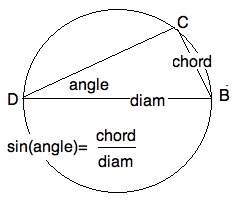 ]
|The sine of an angle.
|===================
.Definition.
****************
The sine of an angle inscribed in a circle is the ratio of the chord
to the diameter of the circle. The sign of the sine is that of the
orientation of the angle: positive for counterclockwise.
****************
The Greeks called the ratio of a secant pass:[$ BC $]
to the diameter pass:[$ DB $] of a circle the 'chord' of the
peripheral angle pass:[$ \angle BDC $] 'subtending' the secant.
As we shall see, this is also the sine of the angle. The word
"chord" was translated into Arabic "jiba" ( from Sanscrit "jya" or
"bow string")
by the scholars in Baghdad who preserved Greek geometry during
the Dark Ages. When Gherardo of Cremona (ca 1150) translated
geometry from Arabic to Latin, he mistook the word for "jaib"
or "bosom, fold in a garment, curve" in Latin, "sinus".
[frame="none",cols="^",valign="middle",grid="all"]
|===================
|pass:[
]
|The sine of an angle.
|===================
.Definition.
****************
The sine of an angle inscribed in a circle is the ratio of the chord
to the diameter of the circle. The sign of the sine is that of the
orientation of the angle: positive for counterclockwise.
****************
The Greeks called the ratio of a secant pass:[$ BC $]
to the diameter pass:[$ DB $] of a circle the 'chord' of the
peripheral angle pass:[$ \angle BDC $] 'subtending' the secant.
As we shall see, this is also the sine of the angle. The word
"chord" was translated into Arabic "jiba" ( from Sanscrit "jya" or
"bow string")
by the scholars in Baghdad who preserved Greek geometry during
the Dark Ages. When Gherardo of Cremona (ca 1150) translated
geometry from Arabic to Latin, he mistook the word for "jaib"
or "bosom, fold in a garment, curve" in Latin, "sinus".
[frame="none",cols="^",valign="middle",grid="all"]
|===================
|pass:[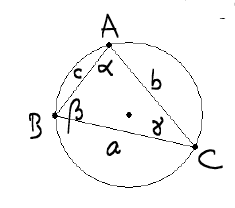 ]
|Standard Labels
|===================
This definition yields an easy proof of the
.Law of Sines (LOS).
********************
Let pass:[$ \triangle ABC $] have sides
labeled pass:[$ a, b, c $] and angles opposite the sides
labeled pass:[$ \alpha \beta \gamma $]. Then
[frame="none",cols="^",valign="middle",grid="none"]
|===================
| pass:[$ \frac{\sin \alpha}{a}=\frac{\sin \beta}{b}=\frac{\sin \gamma}{c} $]
|====================
****************
.Proof.
=====================
From pass:[$ \sin \alpha = \frac{a}{d} $] where pass:[$ d $] is the
diameter of the 'circumcircle' pass:[$ \bigcirc ABC $], we see that
the three ratios each equal the reciprocal of the diameter. Hence they
are equal to each other.
=====================
Peripheral Angle Theorem
------------------------
Of course, this proof begs the question: if the angle is transferred
to a different circle, then the ratio of its new subtended secant to the
new diameter is the same as the old. In particular, we would like to know
that given a secant of a circle, every peripheral angle subtending this
this secant has the same sine in the traditional sense.
[frame="none",cols="^",valign="middle",grid="all"]
|===================
|pass:[
]
|Standard Labels
|===================
This definition yields an easy proof of the
.Law of Sines (LOS).
********************
Let pass:[$ \triangle ABC $] have sides
labeled pass:[$ a, b, c $] and angles opposite the sides
labeled pass:[$ \alpha \beta \gamma $]. Then
[frame="none",cols="^",valign="middle",grid="none"]
|===================
| pass:[$ \frac{\sin \alpha}{a}=\frac{\sin \beta}{b}=\frac{\sin \gamma}{c} $]
|====================
****************
.Proof.
=====================
From pass:[$ \sin \alpha = \frac{a}{d} $] where pass:[$ d $] is the
diameter of the 'circumcircle' pass:[$ \bigcirc ABC $], we see that
the three ratios each equal the reciprocal of the diameter. Hence they
are equal to each other.
=====================
Peripheral Angle Theorem
------------------------
Of course, this proof begs the question: if the angle is transferred
to a different circle, then the ratio of its new subtended secant to the
new diameter is the same as the old. In particular, we would like to know
that given a secant of a circle, every peripheral angle subtending this
this secant has the same sine in the traditional sense.
[frame="none",cols="^",valign="middle",grid="all"]
|===================
|pass:[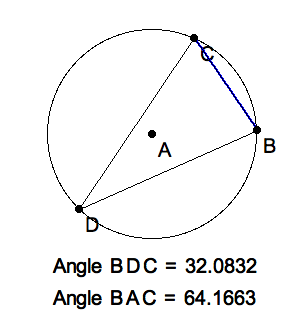 ]
|*Click image to download PAT.seg to explore it in KSEG.*
|===================
.Peripheral Angle Theorem (PAT).
********************************
Given the secant pass:[$ BC $] of a circle, with pass:[$ D $] any other
point moving around the circle, then pass:[$ \sin( \angle BDC ) $]
remains constant.
********************************
.Comment.
===============
We will prove this theorem in 3 steps. The first depends on an 'older'
theorem on exterior angles of Euclidean triangles. By "older", we mean
it was proved closer to the postulates in Euclid's Elements. By keeping
track of the age of theorems we avoid circular reasoning.
===============
.Exterior Angle Theorem (EXT).
******************************
Extend the side pass:[$ AB $] of a pass:[$ \triangle ABC $] past pass:[$ B $]
to pass:[$ D $]. I.e. pass:[$ (ABD) $] are collinear. Then the exterior
angle is the sum of the two oppostite interior angles
[frame="none",cols="^",valign="middle",grid="none"]
|===================
| pass:[$ \angle DBC = \angle BAC + \angle ACB $]
|====================
****************
Proof of EXT
~~~~~~~~~~~~
You should use ruler and compass or KSEG to draw the figure being described
here. We purposely do not include a picture of it so that you can practice
following a description of a figure.
Double the median pass:[$ A A' $] to pass:[$ E $] beyond the midpoint
pass:[$ A' $] of pass:[$ BC $], and connect pass:[$ E $] to pass:[$ B $].
For reference, label a point on pass:[$ (AB)$] beyond pass:[$ B $], i.e.
so that pass:[$ B $] is between pass:[$ A $] and pass:[$ D $].
Because
[frame="none",cols="^",valign="middle",grid="none"]
|===================
|pass:[$ A A' \cong EA' $]
|pass:[$ \angle A A'C \cong \angle EA'B $]
|pass:[$ C A' \cong BA' $]
|====================
We have that pass:[$ \triangle A A' C \cong \triangle EA'B $].
Therefore pass:[$ \angle ACA' \cong \angle EBA' $] and
pass:[$ CA || BE $]. But then
pass:[$ \angle BAC \cong \angle DBE $] and we're done.
.Question 1.
========================
What happens if the triangle is isosceles, with pass:[$ |B-A|=|B-C| $]?
========================
+++++++++++++++++++++++++++
]
|*Click image to download PAT.seg to explore it in KSEG.*
|===================
.Peripheral Angle Theorem (PAT).
********************************
Given the secant pass:[$ BC $] of a circle, with pass:[$ D $] any other
point moving around the circle, then pass:[$ \sin( \angle BDC ) $]
remains constant.
********************************
.Comment.
===============
We will prove this theorem in 3 steps. The first depends on an 'older'
theorem on exterior angles of Euclidean triangles. By "older", we mean
it was proved closer to the postulates in Euclid's Elements. By keeping
track of the age of theorems we avoid circular reasoning.
===============
.Exterior Angle Theorem (EXT).
******************************
Extend the side pass:[$ AB $] of a pass:[$ \triangle ABC $] past pass:[$ B $]
to pass:[$ D $]. I.e. pass:[$ (ABD) $] are collinear. Then the exterior
angle is the sum of the two oppostite interior angles
[frame="none",cols="^",valign="middle",grid="none"]
|===================
| pass:[$ \angle DBC = \angle BAC + \angle ACB $]
|====================
****************
Proof of EXT
~~~~~~~~~~~~
You should use ruler and compass or KSEG to draw the figure being described
here. We purposely do not include a picture of it so that you can practice
following a description of a figure.
Double the median pass:[$ A A' $] to pass:[$ E $] beyond the midpoint
pass:[$ A' $] of pass:[$ BC $], and connect pass:[$ E $] to pass:[$ B $].
For reference, label a point on pass:[$ (AB)$] beyond pass:[$ B $], i.e.
so that pass:[$ B $] is between pass:[$ A $] and pass:[$ D $].
Because
[frame="none",cols="^",valign="middle",grid="none"]
|===================
|pass:[$ A A' \cong EA' $]
|pass:[$ \angle A A'C \cong \angle EA'B $]
|pass:[$ C A' \cong BA' $]
|====================
We have that pass:[$ \triangle A A' C \cong \triangle EA'B $].
Therefore pass:[$ \angle ACA' \cong \angle EBA' $] and
pass:[$ CA || BE $]. But then
pass:[$ \angle BAC \cong \angle DBE $] and we're done.
.Question 1.
========================
What happens if the triangle is isosceles, with pass:[$ |B-A|=|B-C| $]?
========================
+++++++++++++++++++++++++++
+++++++++++++++++++++++++++
The the exterior angle is twice (either) of the opposite interior angles.
pass:[
]
Proof of PAT when angle grazes the center
~~~~~~~~~~~~~~~~~~~~~~~~~~~~~~~~~~~~~~~~~
We can imagine the problem to be that of finding a good place to sit
in a loge of in a circular theater.
'La Scala' and Schakespeare's 'Globe Theater' had its loges arranged
in a circular wall. By the PAT, every loge occupant saw the stage (a
secant) with the same angle, hence the same apparent width.
Of course, the distortion
could not be avoided, and the queen still sat directly in the royal
loge opposite the stage.
[frame="none",cols="^",valign="middle",grid="all"]
|===================
|pass:[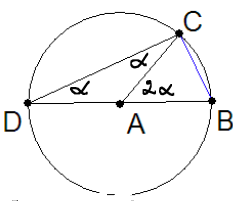 ]
|===================
Let pass:[$ A $] be the center of the circle, a lie on angle-leg
pass:[$ DB $]. By the EXT, the peripheral angle is half the central
pass:[$ \angle BAC $]. Since pass:[$ \triangle DCB $] is inscribed
in a semicircle, it is a right triangle, and
pass:[$ \sin D = \frac{CB}{diameter}$], justifying the two Greek
definitions of the sine of an angle. It also proves
.Corollary.
==============
The length of a secant of a circle is the diameter times the sine
of half the central angle it subtends.
==============
Proof of PAT when angle sees the center
~~~~~~~~~~~~~~~~~~~~~~~~~~~~~~~~~~~~~~~
[frame="none",cols="^",valign="middle",grid="all"]
|===================
|pass:[ ]
|*Click image to download PAT.seg to explore it in KSEG.*
|===================
This means, that pass:[$ A $] lies inside the angle. Draw the
diameter pass:[$ DAE $] and observe that we have two cases of
the first case, one above this diameter, and one below. Thus
[frame="none",cols="^",valign="middle",grid="none"]
|===================
|pass:[$ \angle BDC = \angle BDE + \angle EDC = \frac{1}{2} (\angle BAE + \angle EAC) = \frac{1}{2} \angle BAE $]
|====================
[frame="none",cols="^",valign="middle",grid="all"]
|===================
|pass:[
]
|===================
Let pass:[$ A $] be the center of the circle, a lie on angle-leg
pass:[$ DB $]. By the EXT, the peripheral angle is half the central
pass:[$ \angle BAC $]. Since pass:[$ \triangle DCB $] is inscribed
in a semicircle, it is a right triangle, and
pass:[$ \sin D = \frac{CB}{diameter}$], justifying the two Greek
definitions of the sine of an angle. It also proves
.Corollary.
==============
The length of a secant of a circle is the diameter times the sine
of half the central angle it subtends.
==============
Proof of PAT when angle sees the center
~~~~~~~~~~~~~~~~~~~~~~~~~~~~~~~~~~~~~~~
[frame="none",cols="^",valign="middle",grid="all"]
|===================
|pass:[ ]
|*Click image to download PAT.seg to explore it in KSEG.*
|===================
This means, that pass:[$ A $] lies inside the angle. Draw the
diameter pass:[$ DAE $] and observe that we have two cases of
the first case, one above this diameter, and one below. Thus
[frame="none",cols="^",valign="middle",grid="none"]
|===================
|pass:[$ \angle BDC = \angle BDE + \angle EDC = \frac{1}{2} (\angle BAE + \angle EAC) = \frac{1}{2} \angle BAE $]
|====================
[frame="none",cols="^",valign="middle",grid="all"]
|===================
|pass:[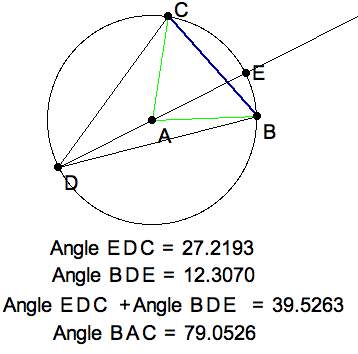 ]
|*Click image to download PATadder.seg which opens in KSEG.*
|
|===================
.Exercise 1.
=====================
Apply a similar argument, with subtraction replacing addition of
periferal and central angles for the last case, that the periferal
angle does not see the center.
=====================
[frame="none",cols="^",valign="middle",grid="all"]
|===================
|pass:[
]
|*Click image to download PATadder.seg which opens in KSEG.*
|
|===================
.Exercise 1.
=====================
Apply a similar argument, with subtraction replacing addition of
periferal and central angles for the last case, that the periferal
angle does not see the center.
=====================
[frame="none",cols="^",valign="middle",grid="all"]
|===================
|pass:[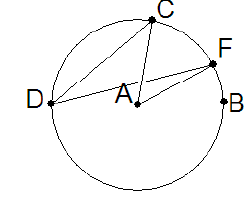 ]
|===================
So, we have exhaustively proved PAT. You should note that we have used
exclusively Euclidean arguments, very possibly the proof that Euclid
wrote in his Elements.
.Question 2.
========================
What happens when the periferal angle dips behind the stage?
========================
+++++++++++++++++++++++++++
]
|===================
So, we have exhaustively proved PAT. You should note that we have used
exclusively Euclidean arguments, very possibly the proof that Euclid
wrote in his Elements.
.Question 2.
========================
What happens when the periferal angle dips behind the stage?
========================
+++++++++++++++++++++++++++
+++++++++++++++++++++++++++
Suddenly the central angle becomes greater than a straight angle. That is,
the periferal angle become obtuse. But since the two central angles add
up to pass:[$ 2 \pi $], any two periferal angles, one "in front" and
one "behind" the secant "stage", become supplementary. But recall, supplementary
angles have the 'same' sine.
pass:[
]
The Cross Ratio is a Perspective Invariant
------------------------------------------
.Definition.
================
The 'cross ratio', pass:[$ CR(A,B,C,D $], of four (distinct) collinear
points, is
pass:[$ CR(A,B,C,D) = \frac{A-B}{A-D} \frac{C-D}{C-B} $]
================
.Definition.
==================
The 'cross ratio', pass:[$ CR(a,b,c,d) $], of four (distinct) concurrent
lines, is
pass:[$ CR(a,b,c,d) = \frac{\sin \angle ab}{\sin \angle ad} \frac{\sin \angle cd}{\sin \angle cb} $]
==================
Note the direction in which we measure a segment matters here,
pass:[$ \frac{A-B}{A-D} = - \frac{B-A}{A-D} $], and so does the
orientation in which we measure an angle, pass:[$ \sin \angle ab = - \sin \angle ba $].
However, for two crossing lines, it doesn't matter which of the two
angles we use; being supplementary, their sins are the same.
For notational symmetry, we have measured the angles clock-wise. It doesn't
matter, as long as are consistent. Changing the sign of an angle changes
the sign of its sin, but not the ratio of two angles whose sign was reversed.
See how it would have been better if Gherardo had used the word "chord".
On the other hand, "cochord" might sound worse than "cosine".
[frame="none",cols="^",valign="middle",grid="all"]
|===================
|pass:[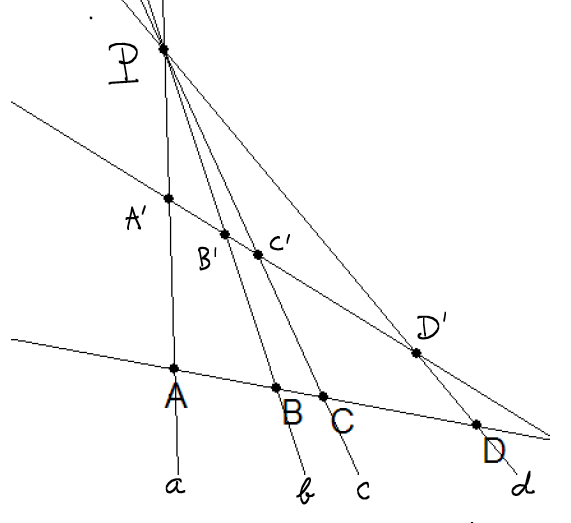 ]
|===================
.Cross Ratio Theorem (CRT).
***************************
Let pass:[$ A, B, C, D $] be four distinct collinear points, and
pass:[$ P $] be any point not on that line. The their cross ratio
depends only on the angles between the concurrent lines pass:[$ a,b,c,d $]
where pass:[$ a = (PA), b= (PB), c= (PC), d=(PD) $].
That is pass:[$ CR(A,B,C,D) = CR(a,b,c,d) (**) $].
***************************
Proof of CRT
~~~~~~~~~~~~
First, we abbreviate pass:[$ sin AB = \sin \angle APB = \sin \angle ab $] etc.
That would be the angles at pass:[$ P $]. Second, we abbreviate
pass:[$ \sin B = \sin \angle PBA = \sin \angle CBP $] because these
two angles are supplementary, and so have the same sines. Finally, we show
that two numbers are equal by showing that their ratios equals pass:[$ 1 $].
[frame="none",cols="^",valign="middle",grid="none"]
|===================
|pass:[$ \frac{CR(A,B,C,D)}{CR(a,b,c,d)}$]
|pass:[$ = \frac{ \frac{A-B}{A-D} \frac{C-D}{C-B} }{ \frac{sin AB}{sin AD}\frac{sin CD}{sin CB} } $]
|pass:[$ = \frac{ \frac{A-B}{sin AB} \frac{C-D}{sin CD} }{ \frac{A-D}{sin AD}\frac{C-B}{ sin CB} } $]
|pass:[$ = \frac{ \frac{P-A}{sin B} \frac{P-C}{sin D} }{ \frac{P-A}{sin D}\frac{P-C}{ sin B} } $]
|pass:[$ = \frac{ \frac{P-A}{P-A} \frac{P-C}{P-C} }{ \frac{sin B}{sin D}\frac{sin D}{sin B} } $]
|pass:[$ = 1 $].
|====================
The rearrangement of the fractions has to be undertood carefully. Since
everything is happening on the same line, we have replaced the
vector pass:[$ A-D $] by its signed length (the direction matters!).
Now we apply the Law of Sines judiciously. Can you find the four triangles
in which we replace ratios? This time we are allowed to replace vectors
by their signed length because all four are concurrent. This is a little
subtle, but has to be said here for completeness.
.Comment.
===================
Pretty neat, huh? Mathematicians die for clever arguments like this. The
alternative is a considerable longer. While each step of the un-clever
argument might be easier to see, there are so many of them that you loose
the forest for the trees.
===================
Two sets of four collinear points, pass:[$ (ABCD), (A'B'C'D') $] are
said to be 'in perspective position', if the four lines
pass:[$ (A'A) (B'B) (C'C) (D'D) $] are concurrent.
s
.Perspective Invariance Theorem (PIT).
***************************************
Two cross ratios of four collinear points in perspective position
are numerically equal.
*************************
Proof of the PIT
~~~~~~~~~~~~~~~~
With pass:[$ a=(A'A) $] etc, observe that
[frame="none",cols="^",valign="middle",grid="none"]
|===================
|pass:[$ CR(A,B,C,D) = CR(a, b, c, d) = CR (A',B',C',D') $].
|====================
Perspective Rulers
------------------
By a 'ruler' we mean a line with a copy of the real numbers marked on
it. Recall from high school, that pass:[$ \ell = (AB) $]
can be given a ruler by assignin pass:[$ A |-> 0 $] and pass:[$ B |-> 1 $].
In particular, we can find all multiples and fractions of unity by
ruler and compass. Multiples are easy.
.Question 3.
========================
How would you subdivide the segment pass:[$ AB $] in 7 equal pieces?
========================
+++++++++++++++++++++++++++
]
|===================
.Cross Ratio Theorem (CRT).
***************************
Let pass:[$ A, B, C, D $] be four distinct collinear points, and
pass:[$ P $] be any point not on that line. The their cross ratio
depends only on the angles between the concurrent lines pass:[$ a,b,c,d $]
where pass:[$ a = (PA), b= (PB), c= (PC), d=(PD) $].
That is pass:[$ CR(A,B,C,D) = CR(a,b,c,d) (**) $].
***************************
Proof of CRT
~~~~~~~~~~~~
First, we abbreviate pass:[$ sin AB = \sin \angle APB = \sin \angle ab $] etc.
That would be the angles at pass:[$ P $]. Second, we abbreviate
pass:[$ \sin B = \sin \angle PBA = \sin \angle CBP $] because these
two angles are supplementary, and so have the same sines. Finally, we show
that two numbers are equal by showing that their ratios equals pass:[$ 1 $].
[frame="none",cols="^",valign="middle",grid="none"]
|===================
|pass:[$ \frac{CR(A,B,C,D)}{CR(a,b,c,d)}$]
|pass:[$ = \frac{ \frac{A-B}{A-D} \frac{C-D}{C-B} }{ \frac{sin AB}{sin AD}\frac{sin CD}{sin CB} } $]
|pass:[$ = \frac{ \frac{A-B}{sin AB} \frac{C-D}{sin CD} }{ \frac{A-D}{sin AD}\frac{C-B}{ sin CB} } $]
|pass:[$ = \frac{ \frac{P-A}{sin B} \frac{P-C}{sin D} }{ \frac{P-A}{sin D}\frac{P-C}{ sin B} } $]
|pass:[$ = \frac{ \frac{P-A}{P-A} \frac{P-C}{P-C} }{ \frac{sin B}{sin D}\frac{sin D}{sin B} } $]
|pass:[$ = 1 $].
|====================
The rearrangement of the fractions has to be undertood carefully. Since
everything is happening on the same line, we have replaced the
vector pass:[$ A-D $] by its signed length (the direction matters!).
Now we apply the Law of Sines judiciously. Can you find the four triangles
in which we replace ratios? This time we are allowed to replace vectors
by their signed length because all four are concurrent. This is a little
subtle, but has to be said here for completeness.
.Comment.
===================
Pretty neat, huh? Mathematicians die for clever arguments like this. The
alternative is a considerable longer. While each step of the un-clever
argument might be easier to see, there are so many of them that you loose
the forest for the trees.
===================
Two sets of four collinear points, pass:[$ (ABCD), (A'B'C'D') $] are
said to be 'in perspective position', if the four lines
pass:[$ (A'A) (B'B) (C'C) (D'D) $] are concurrent.
s
.Perspective Invariance Theorem (PIT).
***************************************
Two cross ratios of four collinear points in perspective position
are numerically equal.
*************************
Proof of the PIT
~~~~~~~~~~~~~~~~
With pass:[$ a=(A'A) $] etc, observe that
[frame="none",cols="^",valign="middle",grid="none"]
|===================
|pass:[$ CR(A,B,C,D) = CR(a, b, c, d) = CR (A',B',C',D') $].
|====================
Perspective Rulers
------------------
By a 'ruler' we mean a line with a copy of the real numbers marked on
it. Recall from high school, that pass:[$ \ell = (AB) $]
can be given a ruler by assignin pass:[$ A |-> 0 $] and pass:[$ B |-> 1 $].
In particular, we can find all multiples and fractions of unity by
ruler and compass. Multiples are easy.
.Question 3.
========================
How would you subdivide the segment pass:[$ AB $] in 7 equal pieces?
========================
+++++++++++++++++++++++++++
+++++++++++++++++++++++++++
If instead of 7 we wanted some power of 2, then taking repeated halves
would solve our problem. In fact, by just marking fractions with powers
of two in their denominator (think of the inch-system) would work quite
nicely in the real world. Such fractions are also called 'binary fractions'.
We can approximate every real number by a sequence of convergent binary
fractions.
But to get an accurate, and for that matter quicker, answer we can use
a similarity theorem from high school geometry. You'll need pencil and
paper to follow along.
On another line pass:[$ AC $] extend pass:[$ AC $] seven times to pass:[$ D $]. Now pass:[$ AC = \frac{1}{7} AD $]. Now draw pass:[$ BD $] and a line
parallel to pass:[$ BD $] through every multiple of pass:[$ AC $] on the
helper line. These mark off seven equal pieces on the given segment
pass:[$ AB $].
pass:[
]
.Comment.
===============
The previous construction is actually a case of PIT, if we understand
'mutually parallel' as 'concurrent at infinity'. Although it is true, we
have not proved PIT for this extended case.
===============
Now, finally, consider a ray in the canvas at pass:[$ V $] and two
points, pass:[$ Q I $] on the ray. Thus in the Euclidean plane of the
canvas pass:[$ (QIV) $]. This represents an infinite line in space, but
in perspective. Equally spaced points on the space line would not be
drawn with equally spaced points in perspective. The points have to
get more and more close to each other as they approach the vanishing
point pass:[$ V $].
To find these milestones you may choose any convenient point pass:[$ P $]
in the canvas, but not on the line pass:[$ (QI) $]. We shall call
pass:[$ P $] a 'lens'. Now choose any
other line parallel pass:[$ s $] to pass:[$ (PV) $] that is convenient
to work with. We shall call pass:[$ s $] a scale for the perspective
line pass:[$ (VIQ) $].
Now transfer pass:[$ Q, I $] to pass:[$ s $] by drawing
lines through pass:[$ P $]. That is
pass:[$ Q' = (QP)s \and I' = (IP)s $].
.Question 4.
========================
Calculate pass:[$ CR(X,Q,I,V) = CR(X',Q',I',V') $] ?
========================
+++++++++++++++++++++++++++
+++++++++++++++++++++++++++
Expanding,
pass:[$ \frac{X-Q}{X-V} \frac{I-V}{I-Q} = \frac{X'-Q'}{X'-V'} \frac{I'-V'}{I'-Q'} $]
Notice the pass:[$ V' $] does not exist. The line pass:[$ (PV) $] is
parallel to the scalin line pass:[$ s $]
and so meets it at pass:[$ \infty $]. If we identify
pass:[$ X' = x, Q' = 0, I' = 1 $] then we should also
let pass:[$ V'= \infty $]. Then the cross ratio becomse
pass:[$ \frac{x-0}{x-\infty}\frac{1-\infty}{1-0} = x $].
This applies a perspective ruler on the perspective line pass:[$ (OQV) $].
Therefore, for two points pass:[$ X(QV) \and Y(QV) $] we can assign the
perspective distance
pass:[$ dist_{QV}(XY) = CR(X,Q,Y,V) = \frac{X'-Q'}{Y'-Q'} $].
pass:[
]
[frame="none",cols="^",valign="middle",grid="all"]
|===================
|pass:[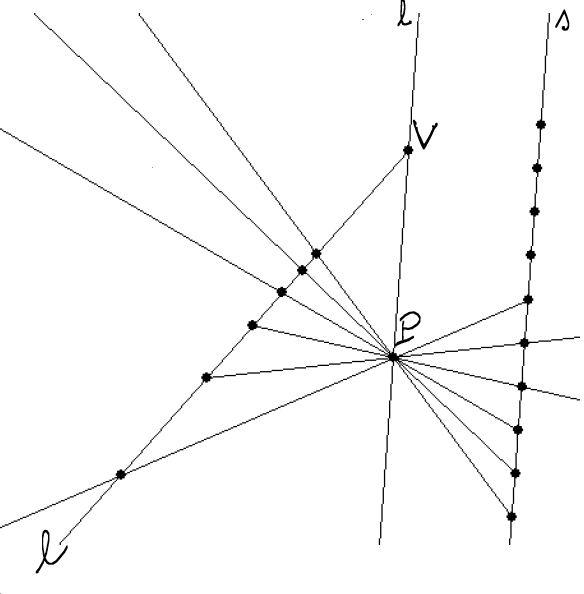 ]
|===================
]
|===================